Governance
Institute for Scientific Integrity
Protect the reliability of published research and institutional measurement.
A New Economic and Institutional Framework
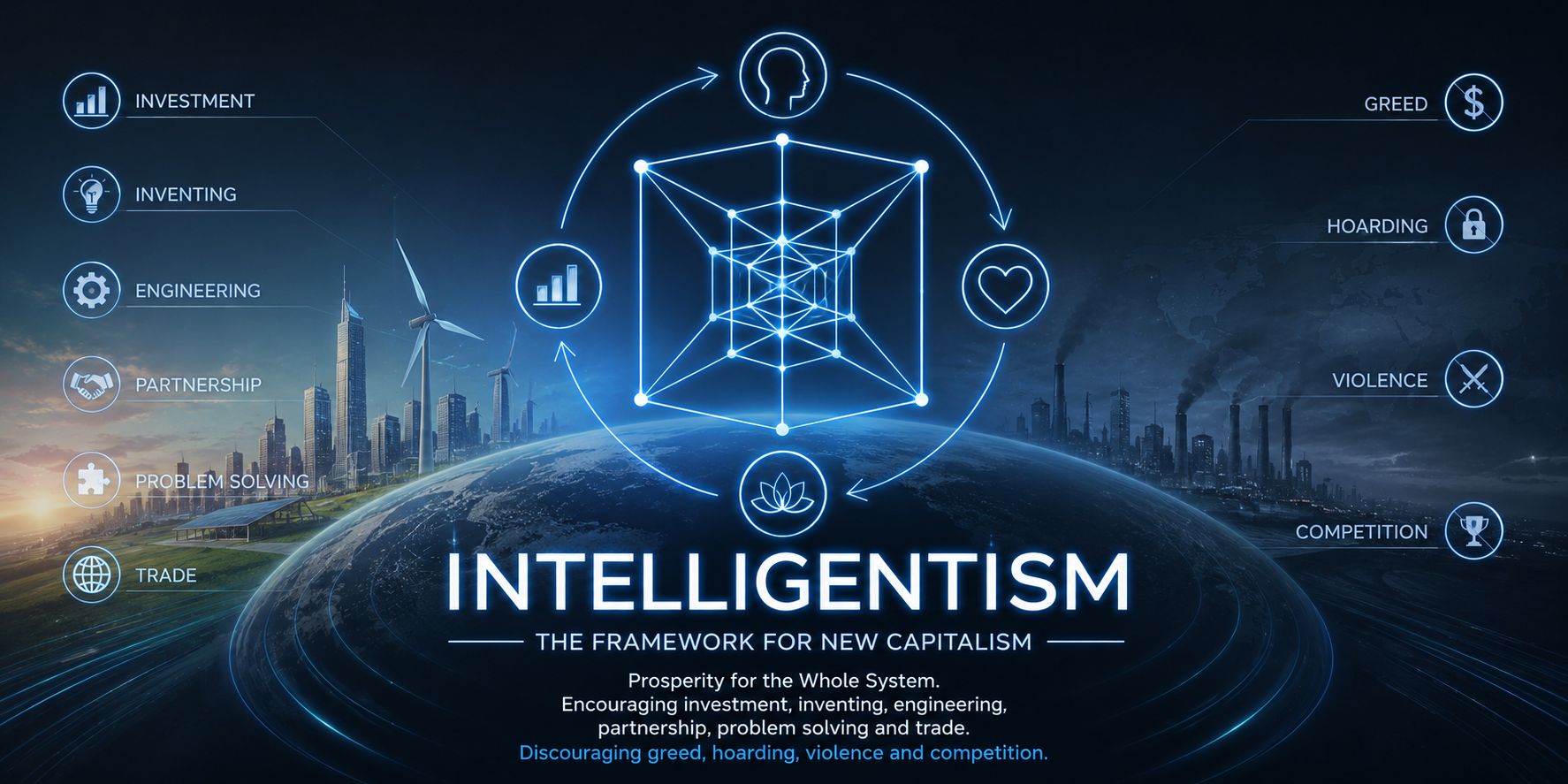
An open framework for optimizing civilization through better incentives, scientific governance, voluntary institutions, engineering, entrepreneurship, investment, and continuous improvement.
Intelligentism preserves the productive power of markets while redesigning the incentives that can reward extraction, hoarding, political capture, artificial scarcity, violence, and destructive competition.
It proposes a voluntary network of mission-driven institutions that provide capital, contracts, technology, infrastructure, research, and market access—and recycle successful returns into future innovation.
Developed and stewarded by the Institute for Scientific Integrity and Legal Policy.
Executive Summary
Intelligentism envisions a new civilization built around win-win capitalism, where markets, entrepreneurship, investment, and private ownership remain powerful engines of progress, but the incentives are redesigned so that capital flows toward invention, infrastructure, productive capacity, and problem-solving rather than extraction, hoarding, artificial scarcity, violence, or destructive competition. In this model, the SpaceX approach becomes a template: ambitious missions attract investment, engineering talent, and commercial demand, then use scale, automation, machine intelligence, algorithms, and better business models to drive costs down, expand access, create entirely new industries, and generate large numbers of high-value jobs. Successful projects recycle much of their economic surplus into the next generation of companies, research, infrastructure, and public-purpose investment, while a portion of system-generated returns can support a universal income and a guaranteed floor of food, housing, utilities, and basic necessities. The goal is not to suppress ambition or wealth creation, but to create institutions and incentives where founders, investors, workers, customers, communities, and future generations can all benefit from the same transaction. By systematically rewarding productivity, innovation, transparency, cooperation, and abundance—and making destructive greed, monopoly capture, rent-seeking, and violence economically less attractive—Intelligentism proposes using the accelerating power of AI and advanced technology to move society from scarcity management toward a continuously improving civilization capable of solving problems at scale.
The starting point
Human beings have built global communications networks, advanced medicine, artificial intelligence, spacecraft, modern agriculture, financial markets, and powerful engineering systems.
Yet enormous productive capacity remains trapped inside systems that often reward the wrong outcomes.
A company may earn more by creating dependence than by creating independence.
An institution may gain more power by expanding a problem than by solving it.
A market participant may profit by restricting supply rather than increasing abundance.
A bureaucracy may preserve itself through complexity, fear, and administrative growth.
A financial owner may extract value from a system while weakening the system that produced that value.
Intelligentism begins with the idea that many of these failures are not failures of intelligence or technology.
They are failures of incentive design.
The central project of Intelligentism is therefore the deliberate redesign of incentives.
What is Intelligentism?
Intelligentism is a framework for organizing economic activity, public-purpose investment, scientific research, institutional governance, technological development, infrastructure, entrepreneurship, capital formation, and long-term prosperity.
Capital should flow toward productive activity, infrastructure, invention, and long-term value creation.
It seeks to preserve
It proposes systems that discourage
Intelligentism is not a completed ideology. It is an open economic and institutional framework that can be modeled, tested, criticized, improved, and implemented gradually.
What Intelligentism is not
Preserves
Recurring weaknesses may include
Frequently seeks
Recurring weaknesses may include
Preserves
Adds
Intelligentism explores a new design space between uncontrolled extraction and centralized control.
Market philosophy
Win-Win Capitalism is the market philosophy operating inside the broader Intelligentism framework. It begins from the premise that trade does not require a permanent loser.
Investment does not have to depend on destructive extraction. Entrepreneurial success does not have to weaken the surrounding system. Institutional support does not have to create permanent dependence.
The ideal transaction should create value for
This is not a claim that all parties receive equal benefits. The goal is to prefer transactions where multiple participants gain and the productive capacity of the system expands.
The 90/10 institutional model
A voluntary institution may provide far more than money. A company or project then uses those resources to build a product, technology, service, or solution.
A voluntary institution may provide
Participant retains
up to 10%
of project profit
Returns to the institution
at least 90%
of project profit
The institution then
Finances additional projects
Returned capital becomes the next round of grants, contracts, and research.
Scope of the agreement
The 90/10 structure applies only to projects voluntarily entered into under an Intelligentism institutional agreement. It is not a universal claim on independently created private wealth.
Independent businesses that do not accept institutional capital or resources remain outside the agreement.
One successful project can finance the next generation of innovation.
Interactive model
Adjust the assumptions and watch institutional capital compound across reinvestment cycles.
$2.32B
Total capital deployed
$9.28B
Total modeled project profit
$927.60M
Entrepreneur profit retained
$8.35B
Capital returned to institutions
4,638
Projects funded across cycles
12,078
Future projects fundable
$11.60B
Estimated economic activity
15 years
Modeled horizon
Institutional capital by cycle
This simulation is illustrative and does not predict investment results. Actual outcomes depend on project costs, failures, timing, legal terms, market conditions, and implementation.
The Value and Settlement Layer
Measure What an Economy Actually Creates
Traditional money records what was paid. Intelligent Currency records what was created.
Traditional money records the amount exchanged. It does not adequately record whether a transaction saved time, transferred knowledge, created future income, reduced risk, improved infrastructure, increased productive capacity, or imposed costs outside the transaction.
Intelligent Currency adds a structured value layer to economic activity.
It records
It is designed for ecommerce, services, research, grants, contracts, institutional projects, and voluntary commercial networks.
Over time, the framework may support a private unit of account governed by transparent reserves, measurable productive capacity, voluntary adoption, audited issuance, and stable purchasing-power objectives.
Price records the exchange. Value records the result.
The prosperity dividend
Every Citizen Shares in the Value the System Creates
Intelligentism proposes that a portion of the profits produced by voluntary institutions, system-owned assets, licensed technologies, infrastructure, investments, and capital-recycling programs be distributed directly to citizens.
Every eligible United States citizen would receive a personal financial account. Each month, the citizen's share of distributable system profit would be deposited into that account with no work requirement, income test, political condition, spending mandate, or repayment obligation.
The system would also guarantee access to essential food, basic housing, essential utilities, and minimum life necessities. The guarantee would establish a floor beneath which no citizen should fall. It would not provide luxury consumption.
People would remain free to earn, invest, build businesses, own property, create wealth, purchase better housing, travel, buy technology, and improve their standard of living through additional productive activity.
Step 01
Productive investment
Capital is placed into things that produce.
Step 02
Invention, enterprise, and trade
Operators build and exchange real output.
Step 03
Institutional project profits
Voluntary institutions record audited surplus.
Step 04
Capital recycling
Surplus returns to new production rather than idling.
Step 05
Public prosperity reserve
A stabilization pool holds obligations first.
Step 06
Universal Beneficial Income
The citizen share is calculated and released.
Step 07
Food, housing, and basic security
The essential floor is met in kind and in cash.
Step 08
Freedom to work, invent, study, care, and build
Ambition is unblocked, not replaced.
Universal Beneficial Income provides a floor, not a ceiling.
The strongest objection
Intelligentism cannot ask a founder to surrender most project profit in exchange for a small grant and bureaucracy. The institution must offer substantially more than money.
It may provide
Intelligentism is not asking entrepreneurs to work for less. It is seeking to give them access to more.
A founder may also benefit through
Voluntary institutions
Intelligentism proposes specialized, semi-autonomous institutions focused on measurable human and economic outcomes.
Governance
Protect the reliability of published research and institutional measurement.
Governance
Design contract, charter, and dispute structures that keep participation voluntary.
Technology
Make advanced compute and models available to builders solving real problems.
Life Sciences
Reduce the cost and delay of validated diagnostics and treatments.
Infrastructure
Expand reliable, affordable, low-harm energy capacity.
Infrastructure
Deliver clean water systems at costs communities can actually afford.
Infrastructure
Increase yield and resilience while reducing input waste.
Infrastructure
Reduce the real cost of safe, durable housing.
Infrastructure
Fund and engineer shared physical systems that raise total productivity.
Infrastructure
Move people and goods with less cost, delay, and harm.
Human Capital
Expand access to verified skill and knowledge at low marginal cost.
Technology
Rebuild the ability to make physical things quickly and affordably.
Technology
Apply autonomy to work that is dangerous, scarce, or wasteful.
Frontier
Reduce the cost of access to orbit and beyond.
Life Sciences
Translate biological research into deployed capability responsibly.
Technology
Discover and industrialize materials that unlock other industries.
Frontier
Measure and repair environmental systems with engineering rigor.
Human Capital
Give capable builders the leverage they cannot buy alone.
Governance
Define prosperity metrics that resist gaming.
Governance
Keep institutional authority limited, replaceable, and lawful.
Participation must be optional
Institutions attract participants by producing useful outcomes rather than by forcing affiliation. The terms must be disclosed before support is accepted.
People and companies may choose to
Safeguards
Scientific governance
Traditional institutions can become trapped by prestige, political identity, administrative inertia, or self-preservation. Scientific governance begins from a different premise.
Every Intelligentism institution should publish
Scientific governance does not mean rule by scientists. It means governance that behaves scientifically.
Government reduction
Intelligentism explores whether many functions currently performed by large bureaucracies could gradually migrate to specialized, transparent, semi-autonomous institutions.
The long-term theoretical objective is to reduce conventional government activity by as much as 99%. This is not an immediate promise, and it is not a proposal for abrupt dismantling.
Any reduction must occur only after replacement institutions demonstrate that they can perform specific functions:
A narrow constitutional government remains responsible for
Transition discipline
Intelligentism favors pilots, transition plans, constitutional safeguards, public consent, and demonstrated replacement—not abrupt dismantling.
Productive competition
Intelligentism does not eliminate competition. It distinguishes between productive and destructive forms.
Productive competition
Destructive competition
The framework should reward competition over
Rights and safeguards
Intelligentism must never become a justification for central control disguised as scientific management.
Practical examples
Illustrative scenarios showing how institutional resources, private execution, and recycled returns could interact.
The institution provides
What happens
A private engineering team develops a modular purification system. The technology produces $12 million in profit.
Under the voluntary agreement
The role of ISILP
The Institute for Scientific Integrity and Legal Policy is a private foundation responsible for researching, developing, testing, publishing, and responsibly stewarding Intelligentism.
ISILP is not the permanent ruler of the framework. Its role is to develop the work, publish evidence, and encourage independent implementations.
Implementation roadmap
Phase 1
Phase 2
Phase 3
Phase 4
Phase 5
Phase 6
Open research questions
Would leading entrepreneurs accept a 90/10 model?
What institutional resources make participation worthwhile?
How should project profit be defined?
How should losses be treated?
How should intellectual property be allocated?
How can institutions avoid monopoly?
How can institutions avoid political or expert capture?
How are leaders selected and removed?
How are disputes resolved?
Which metrics best represent prosperity?
Can recycled capital outperform taxation in selected functions?
Which government functions can migrate safely?
Which functions must remain constitutional?
How should the framework respond to war or disaster?
How can dissent, privacy, and minority rights be protected?
The built environment of Intelligentism
Building Civilization as Art, Infrastructure, and Living Technology
A civilization should not merely function. It should inspire, regenerate, and improve the lives of the people within it.
Architecture Renaissance is the physical design framework of Intelligentism.
It combines the human scale and mathematical proportion of Renaissance architecture, the functional clarity of Bauhaus, the organic integration of Frank Lloyd Wright, the spatial imagination of surrealism, and the capabilities of modern technology.
The objective is not to reproduce the past. It is to recover the ambition that buildings, cities, infrastructure, engineering, art, and public life can form one coherent system.
Buildings and cities should be
The city is not a machine for consuming life. It is an instrument for expanding it.
What it covers
Explore the framework
The full visual essay includes concept galleries, system diagrams, pilot phases, risks, and open research questions.
Architecture Renaissance is a concept framework. Every city, house, and system shown is a research proposal for modeling and criticism, not a built project.
Practical Plan
A better civilization will not emerge from theory alone. It requires a practical economic engine capable of converting private ambition, technological progress, and investment capital into permanent public abundance.
The model begins with a new class of growth entrepreneurs: founders, investors, operators, technologists, and business builders who continue to create wealth, but who deliberately commit a substantial portion of their income and investment returns to productive infrastructure. Rather than treating philanthropy as an afterthought, capital formation itself becomes part of the social architecture. Wealth is continuously recycled into projects that make society more capable, more efficient, and less dependent on scarcity.
Those investments can finance advanced transportation networks, intelligent cities, automated manufacturing, education centers, energy systems, research campuses, robotic agriculture, vertical farms, edible landscaping, water infrastructure, housing systems, communications networks, and other assets that improve the productive capacity of civilization.
The critical difference is that these projects are not conceived merely as charitable expenditures. They are designed as productive, revenue-generating infrastructure.
A transportation corridor can generate user fees. An advanced manufacturing complex can generate operating income. A robotic orchard can sell food while reducing labor and resource costs. A research campus can commercialize discoveries. Intelligent housing and utility systems can generate recurring revenues while lowering the cost of living. Education centers can create skilled workers who, in turn, create new companies, technologies, and economic activity.
The profits generated by these assets can then flow back to the Institute for Scientific Integrity and Legal Policy, where they are reinvested into the next generation of infrastructure and civilization-building projects.
The self-reinforcing economic loop
Over time, the system becomes increasingly self-financing.
Instead of wealth accumulating indefinitely in passive stores of capital, a growing portion is continuously redirected toward assets that increase civilization's productive capacity. The objective is not to eliminate private wealth or entrepreneurial reward. It is to create a structure in which the most successful participants have a powerful incentive to keep building.
01
SpaceX demonstrates an important principle: extraordinarily ambitious infrastructure can become economically viable when engineering innovation, private investment, government demand, automation, and entrepreneurial execution are aligned around a clear mission.
The same logic can be applied far beyond rockets.
Each successful system lowers the cost of the next one.
02
Many social problems ultimately originate in scarcity: insufficient housing, expensive food, limited educational opportunity, inadequate transportation, energy constraints, lack of healthcare access, or insufficient economic opportunity.
Machine intelligence gives civilization an unprecedented ability to attack these problems systematically.
Artificial intelligence can optimize transportation systems, energy grids, crop yields, construction schedules, manufacturing, logistics, education, healthcare delivery, capital allocation, and scientific research. Robotics can increasingly perform repetitive physical work. Algorithms can identify inefficiencies that human institutions have tolerated for decades.
The result can be a society in which the cost of providing basic necessities steadily declines.
As productivity rises, part of the economic surplus generated by automated infrastructure can support a universal economic floor—whether through direct income, public dividends, subsidized necessities, or universal access to essential services.
The purpose of such a system is not to remove the incentive to work.
It is to remove the fear of destitution.
People should still be rewarded for creating, inventing, building, investing, teaching, discovering, and taking productive risks. But access to food, shelter, education, communication, transportation, and basic healthcare should increasingly become a consequence of civilization's productive capacity rather than an individual's ability to survive economic instability.
03
Under this model, the highest form of wealth is not possession.
It is productive capacity.
A society becomes genuinely wealthy when it can reliably produce food, energy, housing, transportation, knowledge, technology, healthcare, education, and opportunity at progressively lower cost.
Capital therefore becomes most valuable when it is transformed into systems that continue producing value long after the original investment has been made.
The greatest return on investment may ultimately be the creation of infrastructure that continuously produces additional opportunity.
04
The transition to a more intelligent civilization depends on incentives.
Human beings respond to systems that reward particular behaviors. If financial structures reward extraction, monopolization, speculation, violence, or scarcity, those activities will flourish.
If systems reward innovation, infrastructure, productivity, scientific discovery, cooperation, and long-term value creation, capital and talent will increasingly move in those directions.
The goal is therefore not to attempt to eliminate ambition.
It is to redirect ambition toward civilization-building.
Entrepreneurs should be able to become extraordinarily successful. Investors should earn strong returns. Engineers should be rewarded for breakthroughs. Workers should share in productivity gains. Communities should benefit from infrastructure development.
The system works when the same project can create value simultaneously for investors, workers, customers, communities, and society.
That is the essence of a win-win economy.
05
The most important feature of this model is compounding.
Eventually, civilization itself begins to behave like a compounding investment portfolio.
The objective is not a single utopian project.
It is a system that continuously improves itself.
A civilization where entrepreneurship generates infrastructure, infrastructure generates abundance, abundance expands opportunity, and opportunity produces the next generation of entrepreneurs, scientists, engineers, artists, and builders.
That is how a win-win economy becomes more than an idea.
It becomes an operating system for civilization.
Goal 1
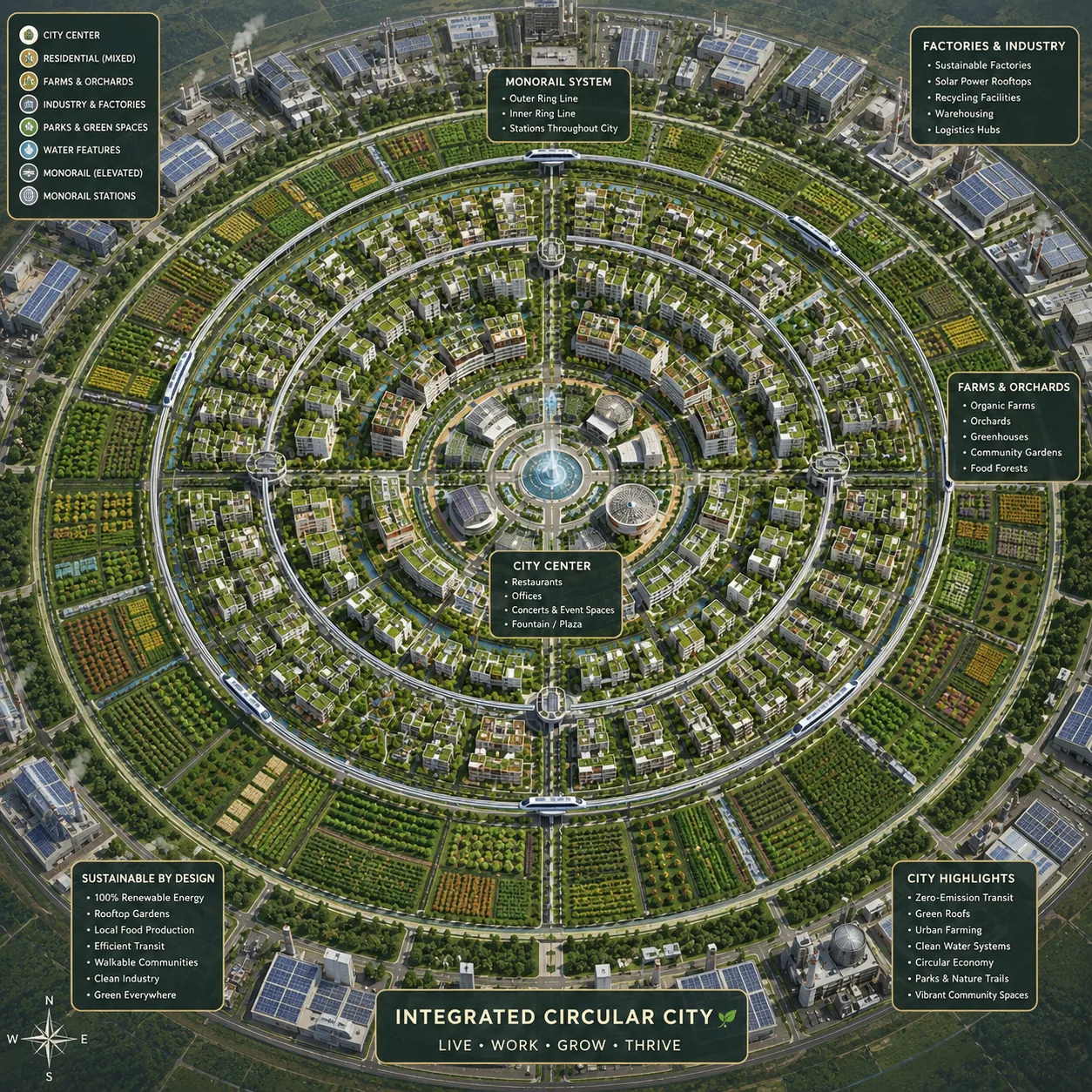
The first practical application of this plan is a real, working model city: a self-maintained super city designed for about 5,000 residents and 1,000 businesses.
The city combines housing, advanced manufacturing, clean energy, water systems, food production, tourism, and public transit in one integrated environment. It is both a thriving community and a demonstration city that proves what practical, future-ready infrastructure can look like.
The city is organized as concentric rings around a central core, connected by an elevated electric monorail, and designed to run on closed-loop water, local food, and renewable energy.
How we will build it
Secure the land and complete the master plan, engineering, and approvals.
Install utilities, fiber, roads, water systems, and clean power.
Open the city center, housing, workspaces, and essential services.
Build advanced manufacturing, research facilities, and logistics systems.
Develop hotels, expos, museums, and visitor attractions.
Use operating revenue and partnerships to expand the city over time.
Target outcomes
5,000
Residents
1,000
Businesses
~5 km
City diameter
~40%
Green space
100%
Renewable energy
100%
Water recycling
Districts and core systems
Sustainability at scale
It becomes an operating system for civilization.
Goal 1
The objective is to develop a working demonstration city that proves advanced technology, modern infrastructure, efficient government, clean industry, intelligent transportation, local food production, and high-quality urban living can be integrated into one economically viable system. The city will be designed for approximately 5,000 residents and 1,000 businesses, with people living, working, manufacturing, researching, learning, visiting, and building companies within the same environment.
The project should function simultaneously as a real community, advanced manufacturing hub, research campus, tourism destination, policy laboratory, and global showcase for future infrastructure.
Core design targets
01
The city will begin with a multidisciplinary engineering and design program involving civil engineers, structural engineers, architects, transportation engineers, mechanical engineers, electrical engineers, water engineers, materials scientists, agricultural engineers, robotics specialists, software engineers, urban planners, environmental scientists, economists, and construction professionals.
The master plan should be developed as an integrated engineering system rather than as a conventional real-estate subdivision. Transportation, utilities, buildings, water, energy, communications, waste handling, food production, and public spaces should be designed together from the beginning.
A full digital twin of the city should be created before major construction begins. Engineers will model:
The city should be treated as a continuously optimized machine.
02
Construction should incorporate the most advanced economically viable building methods available at the time of development.
Priority technologies should include:
Buildings should be designed for long service life, low maintenance, energy efficiency, adaptability, and rapid repair.
Where possible, building systems should be standardized so components can be manufactured locally, replaced quickly, and upgraded without demolishing entire structures.
03
A primary goal is to reduce the lifetime cost of maintaining the city.
Sensors, robotics, AI, and predictive analytics should continuously monitor:
Maintenance should increasingly become predictive rather than reactive.
Robotic inspection vehicles, drones, automated cleaning systems, autonomous landscaping equipment, and sensor-driven maintenance platforms should handle routine inspection and upkeep.
The city should operate with a centralized infrastructure-control platform capable of identifying problems before they become failures.
04
A substantial portion of the city should be dedicated to clean advanced manufacturing.
Target sectors may include:
The manufacturing district should include shared laboratories, prototype facilities, robotics cells, machine shops, logistics centers, testing facilities, and flexible industrial buildings.
The goal is to make it possible for a startup to move from idea → prototype → pilot manufacturing → scaled production without leaving the city.
05
The city should deliberately recruit approximately 1,000 businesses across technology, manufacturing, hospitality, professional services, research, retail, entertainment, education, healthcare, food, and infrastructure.
A portion of commercial space should be reserved for startups and emerging companies.
The city should provide:
The objective is to create a dense environment in which companies can grow faster because engineering, capital, talent, customers, suppliers, and infrastructure are physically close together.
06
The city should be a place where people genuinely want to live.
Housing should include apartments, townhomes, family housing, senior housing, workforce housing, and premium residences.
Residential districts should be:
Residents should be able to reach most daily destinations without needing a private automobile.
The city should demonstrate that technologically advanced urban development can also be comfortable, beautiful, healthy, and family-oriented.
07
The transportation network should be planned before major development begins.
A high-capacity electric monorail or comparable grade-separated transit system should connect the principal districts:
City Center → Residential Districts → Manufacturing → Research & Education → Tourism District → Hotels & Expos → Agriculture → Transit Hubs
The target should be frequent service, short wait times, minimal congestion, and high reliability.
Autonomous shuttles, bicycles, pedestrian paths, and limited road traffic can complete the local mobility network.
The city should serve as a live demonstration of what transportation looks like when transit infrastructure is incorporated into the original urban design rather than added decades later.
08
Food production should be incorporated into the physical design of the city.
Systems may include:
Fruit trees and productive vegetation can replace some purely decorative landscaping.
The objective is not complete agricultural isolation. It is to demonstrate that cities can produce a meaningful portion of their own fresh food while improving aesthetics, resilience, education, and public health.
09
The city should be designed to attract visitors.
A dedicated tourism and hospitality district should include:
The city itself becomes the exhibit.
Visitors should be able to see advanced manufacturing, automated transit, robotic agriculture, intelligent buildings, water recycling, renewable energy, AI systems, and new construction techniques operating in the real world.
This creates tourism revenue while also attracting investors, companies, engineers, students, policymakers, and potential residents.
10
The city should ultimately function as a physical proof of concept.
Instead of publishing reports about future cities, we build one.
Engineers can test systems. Manufacturers can demonstrate products. Universities can conduct research. Governments can evaluate policy. Investors can evaluate technologies. Architects can test new designs. Companies can establish pilot operations. Visitors can experience the results directly.
The city should become a place where organizations come to answer a simple question:
What does the next generation of civilization actually look like when the technologies already available to us are integrated intelligently?
11
Development should occur in measurable phases.
Master plan, site selection, engineering, legal structure, zoning, environmental review, financing, and digital twin.
Energy, water, fiber, roads, utilities, initial transit, drainage, and central infrastructure systems.
Initial housing, city center, research facilities, hotel, commercial space, and first employers.
Factories, laboratories, incubators, education centers, logistics, and advanced production facilities.
Expansion toward 5,000 residents and 1,000 businesses.
Museums, expos, tourism, international conferences, demonstration centers, expanded hotels, and global partnerships.
12
Success should be quantified.
Key performance indicators should include:
The objective is not to claim sustainability or efficiency. It is to measure and prove it.
The End State
The completed project should be a self-maintained, economically productive, technologically advanced city where 5,000 people live, 1,000 businesses operate, advanced products are manufactured, food and energy are increasingly produced locally, visitors come to see the future, and engineers continuously improve the systems that make the city work.
It should be simultaneously a city, laboratory, factory, university, tourist destination, investment platform, and blueprint for replication elsewhere.
What does the next generation of civilization actually look like when the technologies already available to us are integrated intelligently?
Goal 2
The second goal is to move beyond a single demonstration city and create a network of advanced cities that function as one distributed civilization platform. Each city should retain its own economic identity and specialization while sharing transportation, research, education, communications, manufacturing capacity, energy systems, and scientific infrastructure.
The objective is to create multiple self-maintained cities that are physically, digitally, economically, and intellectually connected—forming a scalable model for regional, national, and eventually planetary development.
Develop a network of multiple Super Cities, each designed around the principles established in Goal 1:
Core target
Each city becomes both an independent center of productivity and a node in a larger civilization-scale network.
01
Not every city should be identical.
Each location should develop areas of specialization based on geography, industry, talent, energy resources, transportation access, and strategic value.
Examples may include:
Robotics, aerospace, advanced materials, precision manufacturing, automation, and industrial-scale production.
Physics, materials science, energy systems, artificial intelligence, biotechnology, communications, and advanced engineering.
Universities, technical institutes, trade schools, research academies, entrepreneurship programs, and lifelong education.
Robotic agriculture, vertical farming, seed research, food science, water systems, and regenerative land management.
Launch systems, propulsion research, spacecraft manufacturing, satellite systems, astronomy, and space sciences.
Advanced generation, grid research, storage systems, hydrogen, geothermal, solar, nuclear research, and next-generation energy technologies.
The cities should complement one another rather than duplicate every capability.
02
The cities should eventually be connected by high-speed underground transportation and utility corridors.
Tunnel networks can carry:
Separating high-volume transportation and utilities from surface streets creates more space for parks, housing, agriculture, pedestrians, and public life.
The long-term target should be an underground infrastructure grid connecting cities in the same way that highways, railroads, pipelines, and fiber networks connected earlier generations.
03
Between cities, the system should support progressively faster transportation technologies.
Initial systems may include electric rail, high-speed rail, autonomous freight corridors, advanced monorail systems, and tunnel-based rapid transit.
Future systems could incorporate:
The engineering objective is to steadily reduce the time and cost of moving people, products, energy, and information between cities.
A network of cities becomes substantially more valuable when residents can realistically live in one city, work in another, study in another, and access specialized services throughout the system.
04
Every Super City should participate in a common research network.
Major research centers should share:
A discovery made in one city should be available to researchers throughout the network.
AI can continuously analyze research conducted across all locations, identify relationships between fields, suggest experiments, and accelerate scientific discovery.
The goal is to make the entire city network operate like a distributed research institution.
05
Education should be treated as infrastructure rather than as a separate social service.
Each city should include advanced learning institutions connected to the industries and research activities operating there.
Students should be able to move directly between: Education → Research → Apprenticeship → Employment → Entrepreneurship.
Programs should emphasize:
The system should encourage continuous retraining as technologies evolve.
The objective is to create cities that continuously produce the people needed to operate and improve them.
06
The Super City network should support a highly resilient communications architecture.
Infrastructure should include:
Telecommunications infrastructure should be designed with redundancy so that no single failure can isolate a city.
These networks should support government, research, commerce, education, healthcare, transportation, and emergency operations.
07
The city network should also support fundamental research into communications beyond conventional terrestrial systems.
Research areas may include:
Any research concerning communications with possible extraterrestrial or non-human civilizations should be conducted through rigorous scientific methods, transparent evidence standards, and international cooperation.
The immediate engineering value of this work is substantial even without assuming such contact exists: technologies developed for extreme-distance communication can improve satellite systems, astronomy, navigation, cryptography, and deep-space exploration.
08
The long-term system should extend beyond Earth.
Super Cities can support the industries required for space development:
The objective is to gradually create a complete industrial ecosystem capable of supporting sustained activity in orbit, on the Moon, and eventually farther into the solar system.
Rather than treating space exploration as isolated missions, the cities should provide the manufacturing, scientific, educational, and economic base required for permanent expansion.
09
Long-term development should include research facilities beyond Earth.
Potential stages include:
Research, manufacturing, communications, astronomy, and materials science.
Science, mining research, astronomy, construction experiments, energy generation, and long-duration habitation.
Propulsion, radiation protection, autonomous construction, closed-loop agriculture, and long-duration human systems.
Each stage should produce technologies that also improve life on Earth.
10
The cities should operate as one distributed industrial system.
Manufacturing capacity should be digitally coordinated so that products can be designed in one city, prototyped in another, manufactured in another, and distributed throughout the network.
AI systems can optimize:
This creates resilience.
If one factory or region experiences disruption, production can shift to another location.
11
The cities should also share energy infrastructure.
A regional smart grid can move electricity between locations depending on demand and generation.
Different cities may specialize in different forms of generation:
Energy abundance becomes more achievable when production is distributed but interconnected.
12
Eventually, the entire network should operate through a shared digital model.
Each city maintains its own digital twin while contributing data to a broader civilization-scale digital twin.
The system can model:
AI systems can simulate policy and engineering decisions before they are implemented.
This allows lawmakers and engineers to evaluate likely outcomes using real operational data rather than assumptions alone.
13
The network should not be limited to one country.
Partner cities, research institutions, governments, companies, and universities around the world should be able to participate.
A global network could allow each region to contribute its strongest capabilities while sharing discoveries, technology, educational resources, and infrastructure designs.
The purpose is not to create isolated technological enclaves.
It is to create replicable infrastructure standards that other communities can adopt and improve.
14
Complete and validate the first Super City.
Build specialized cities with complementary economic and research functions.
Connect cities through high-speed transportation, tunnels, energy, data, and logistics infrastructure.
Establish standardized city designs, research systems, manufacturing networks, and shared infrastructure.
Develop compatible Super Cities and research centers internationally.
Connect Earth-based industrial and research networks with orbital and lunar facilities.
15
Key metrics should include:
The End State
Goal 2 is the creation of a distributed civilization infrastructure: multiple technologically advanced cities connected by tunnels, high-speed transportation, communications networks, research institutions, educational centers, manufacturing systems, energy grids, and eventually space infrastructure.
People should be able to live in one city, work with another, study through the entire network, manufacture products across several locations, conduct international research, and participate in industries extending from Earth into space.
The first Super City proves the model.
The network makes the model scalable.
And over time, that network becomes the physical, scientific, and economic foundation for a more advanced civilization.
The first Super City proves the model. The network makes the model scalable.
Productive landscapes
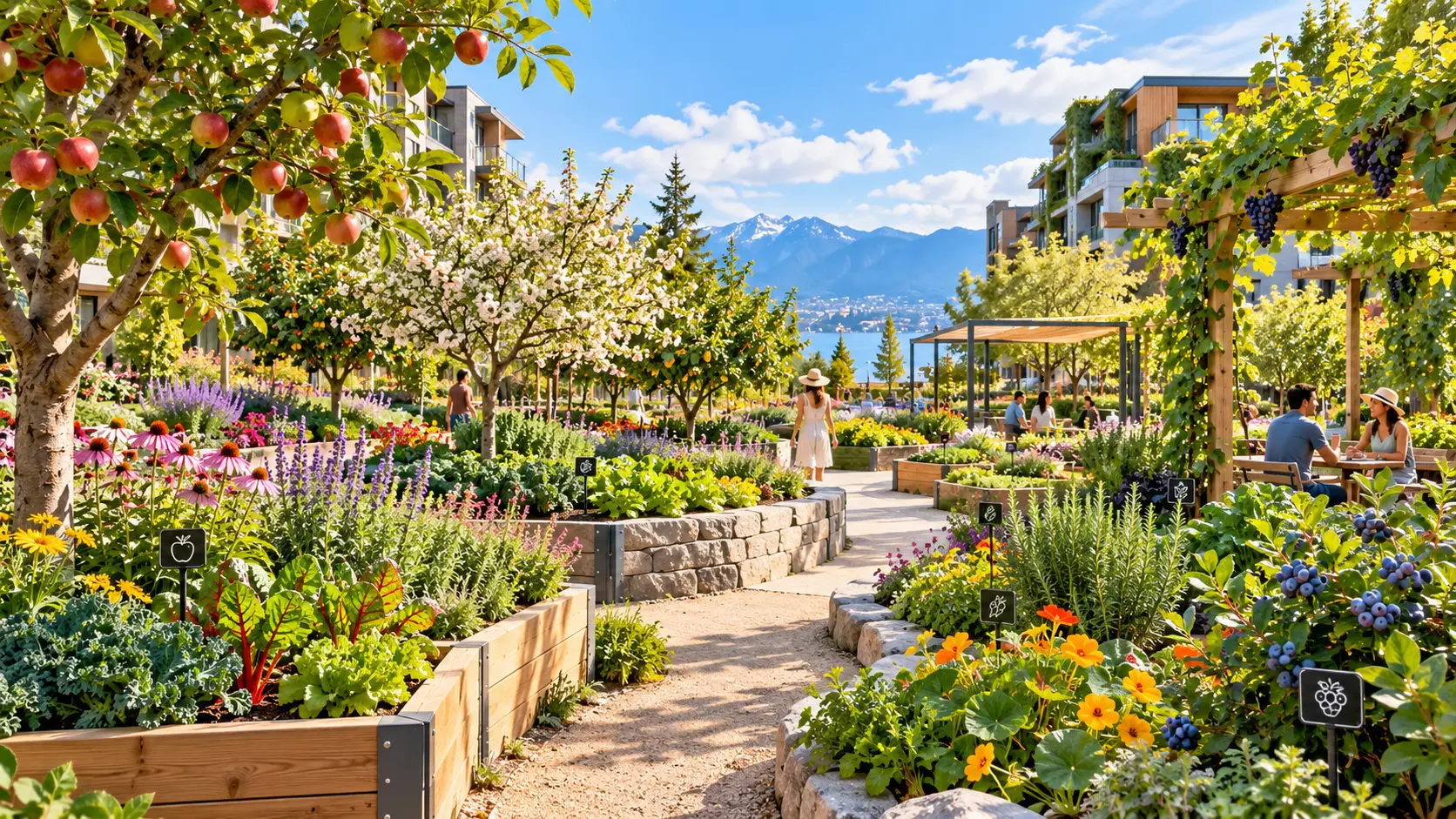
Edible landscaping can turn the enormous amount of land already devoted to lawns, medians, parks, campuses, roadsides, and ornamental plantings into a distributed food system without requiring entirely new farmland.
If communities systematically rotated fruit and nut trees, berries, perennial vegetables, herbs, and climate-appropriate food crops through public and private landscapes, the aggregate output could become significant: at national scale, even modest productivity across tens of millions of suitable acres could yield billions of pounds of food annually, while an individual state could potentially produce hundreds of millions of pounds depending on climate, population density, and available land.
Land already in use
Rotated through those landscapes
The value is not only the calories produced. Edible landscaping also:
In an Intelligentist model, landscaping is no longer treated as purely decorative infrastructure—it becomes part of the food, environmental, and economic system, with rotational planting ensuring diversity, soil health, continuous harvests, and long-term productivity.
Landscaping becomes part of the food, environmental, and economic system.
Final invitation
The systems inherited from the past were not designed for artificial intelligence, autonomous machines, global digital networks, advanced biotechnology, planetary engineering, or technological abundance.
They solved important problems. They also created new ones.
Intelligentism begins with the belief that civilization can examine its incentives with the same seriousness used to examine a bridge, a medical treatment, a spacecraft, or a computer system.
Spread the word
This framework grows through people who read it, test it, and pass it on. Send it to someone who builds, invests, researches, or governs.
https://intelligentism.isilp.org